
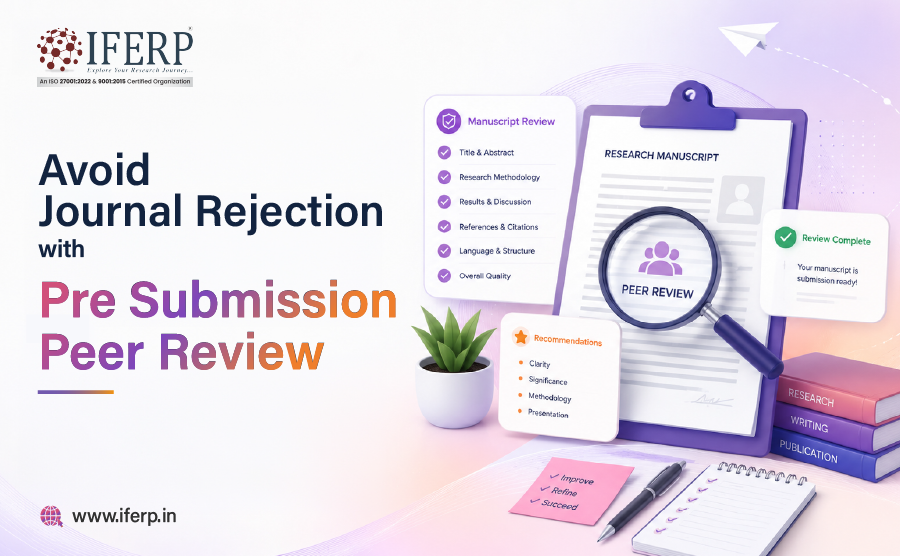
Avoid Journal Rejection with Pre-Submission Peer Review
 July 20, 2026
 peer review, pre submission peer review service, Uncategorized
Have you spent months researching, gathering information, and preparing your writing manuscript, but it gets rejected by the journal? This happens with most researchers, and it feels very frustrating. But, with the help of pre submission peer review you can improve your chances of acceptance in the desired journal.
In many situations, the rejection has nothing to do with the research, but with certain problems in the manuscript, like confusing writing, formatting errors, bad methodology, or failing to meet the journal’s criteria. So, before submitting the article, you can choose a subject expert or pre-submission services to get your manuscript review by experts.
In this article, we have explained everything related to such services. Take a look!
What Is Pre-Submission Peer Review?
An internal or external evaluation of your article or other academic work prior to submission to a journal is known as a pre-submission review. Authors sometimes choose other researchers or third-party service providers to check the manuscript for flaws, clarity, originality, and plagiarism.
The pre-submission review process helps
-
- You understand how reviewers may perceive your work.
- Provides you an overall assessment for readability, narrative flow, ethics compliance, and paper quality.
Why Do Journals Reject Research Papers?
Here are some reasons responsible for the rejection of research work:
Poor quality of research: If your research lacks a proper goal, valuable information, quality analysis, and substantive conclusions, it may get rejected by the journal.
Mismatch of journal scope: You have chosen the wrong journal, and your research topic is not suitable for that journal, which is the reason why it gets rejected.
Flaws in methodology: A wrong research plan, methodology used, and unethical way of data collection result in rejections.
Poor English: When there are many mistakes in language, expressions, and construction of the piece of writing, it faces rejection.
Formatting issues: Submission does not comply with the journal’s instructions regarding authors’ formatting, citation, tables, figures, and number of words.
Plagiarism and ethical issues: If you have copied the work without adding new research or value, it is considered plagiarized. Any plagiarism in a research paper is not welcomed by journals, including Scopus indexed journals.
Poor discussion or conclusion: The discussion does not describe the importance of the research results, or the conclusions are not supported by the data.
Lack of novelty: The article does not provide any new results or important findings in the current research.
Incomplete citations: Lacking, incorrect, and outdated references lower the quality of the paper.
Not paying attention to reviewer suggestions: When recommendations from the reviewers are not applied, the paper might be rejected in the next review.
How Pre-Submission Peer Review Helps Avoid Journal Rejection
Here is how pre-submission peer review services can help you avoid journal rejection:
Review of Research Quality
Deep evaluation of the research quality is one of the main benefits of the pre-submission peer review process. Reviewers, who are independent experts, assess whether or not your research study has addressed the desired research problem, presented original findings, and concluded important knowledge. They also judge whether objectives, findings, and conclusions are logically coherent. Experts help you understand the weak points in the manuscript and suggest ways to improve it.
Identification of Methodological Weaknesses
Many papers are rejected due to research design or methodology deficiencies. In a pre-submission review, experts assess your methods, sample size, data collection, and the design of the research to find weaknesses. They guide you on how to properly conduct an original experiment, spot missing information, and suggest modifications to improve findings. Thus, resolving the identified issues at an early stage enhances the manuscript’s credibility.
Language and Readability Improvements
A well-written manuscript is easy for the journal reviewers. Therefore, pre-submission review checks your paper for technical issues, grammatical errors, and spelling mistakes. They also review your paper for structure, formatting, images, and references. After this, the reviewer sends you suggestions on how to improve the text and to make it more informative and appealing.
Structure and Organization Assessment
Academic journals are expected to have a well-organized structure. Throughout the evaluation process, editors will look at the title, abstract, introduction, methods, results, conclusion, graphs, and tables and ensure that they are presented in an orderly manner. They will also check if the sections need to communicate the thesis.
Statistical Analysis Review (when applicable)
When your research is based on quantitative data, precise statistics play an important part in the research work. The pre-submission reviewers check the relevant statistics used in the research and whether data interpretation has been conducted adequately. Proper reporting of statistics increases confidence in findings and helps avoid reviewers’ difficulties during the review of journals.
Reference and Citation Review
When research is based on quantitative data, precise statistics play an important part in the research work. The reviewers check the relevant statistics used in the research, the interpretation of results, and whether data interpretation has been conducted adequately. Proper reporting of statistics increases confidence in findings and helps avoid reviewers’ difficulties during the review of journals.
Ethical Compliance Check
Mistaken or unfinished referencing is one common cause for the revision of manuscripts. A pre-submission review must involve citations being checked for accuracy and compliance with the referencing style of the journal to which the submission is to be made. The referees may suggest incorporating some new and relevant studies in order to make the review stronger and demonstrate the knowledge of the latest findings in the field.
Step-by-Step Pre-Submission Peer Review Process
Here are the steps of the pre-submission peer-review process:
Step 1: Write Your Manuscript
Write your research report, complete various sections such as name, abstract, introduction, methodology, results, discussion, conclusion, and list of references. Ensure that your manuscript is ready before approaching a reviewer for the pre-submission process.
Step 2: Choose the Right Peer Review Service or Peer Reviewers
Select an experienced peer reviewer who possesses knowledge about the area of your research. You may either seek assistance from the university teachers, senior research scholars, subject matter specialists, or professional peer review services.
Stage 3: Presenting Your Manuscript for Assessment
You must give your manuscript to the reviewer as well as the proposed journal (if selected) and any particular points you would like the reviewer to evaluate. This assists the reviewers in giving more effective and accurate feedback.
Stage 4: Get Constructive Feedback from the Reviewer
The reviewer will analyze your manuscript for research quality, uniqueness, methodology, language, formatting, structure, references, and ethical issues. He will give you constructive feedback where he will stress the advantages and drawbacks.
Stage 5: Make Changes to the Manuscript
You should read each remark and make the changes, if needed. Strengthen the weak points, explain your purpose clearly, update the references, and correct all the language mistakes in your paper.
Step 6: DO a Last Quality Check
Before submitting your manuscript, please thoroughly review the document for grammar, spelling, format, plagiarism, citations, tables, figures, and the journal editor’s instructions. Also, ensure that all requested documents like declarations, etc. are included.
Step 7: Submit to the Target Journal
After completing all revisions, submit the manuscript to the most appropriate journal. The more revisions and reviews your piece goes through, the less likely it will have problems at the editorial stage and during peer review.
What Reviewers Typically Check
As part of the peer review process, the pre-submission reviewers will determine whether the paper satisfies the publishing and academic requirements of the journal. Here is what they focus on:
- Research Novelty: Peer reviewers will determine if the research presented in the manuscript offers novel information about the subject matter and fulfills the requirement of the research to make a contribution to the discipline.
- Study Objectives: Peer reviewers will check if the goals and objectives of the research are made clear and whether they are consistent with the content of the paper.
- Literature Review: It assesses whether a candidate has included up-to-date, valid, and relevant journal publications in their research proposals.
- Research Methodology: It evaluates whether procedures, research design, number of participants, and techniques of information collection are consistent with the objectives of the study.
- Data Analysis: It checks if the data is processed properly and the outcomes of the analysis tie in with the goals of the research.
- Results: The reviewers assess whether the results are clear, accurate, and presented with the relevant data sources.
- Discussion: The reviewers of manuscript editing services assess if the reasons for the findings have been explained, compared with previous research, and limitations of their study have been noted.
- Conclusion: They review whether the conclusion summarizes the research appropriately and is supported by the study results.
Pre-Submission Peer Review vs Journal Peer Review
Here is a tabular difference between pre-submission peer review vs journal peer review:
| Feature | Pre-Submission Peer Review | Journal Peer Review |
| Timing | Before submission | After submission |
| Reviewer | Independent expert | Journal-selected reviewer |
| Purpose | Improve manuscript | Editorial research publication decision |
| Revision opportunity | Before submission | During review process |
Conclusion
Pre-submission peer review before submitting a manuscript is useful for enhancing its quality prior to journal submission. Insights obtained from experts will prove useful in identifying deficiencies, improving the research conducted, and minimizing mistakes that usually result in journal rejection. Although there is no guarantee of publication through peer review, it enhances one’s prospects of getting the manuscript accepted and makes it possible to submit the research paper in a well-planned and efficient manner.
FAQs
How does pre-submission peer review help reduce journal rejection?
Publication support services identify weaknesses in your research quality, methodology, writing, and formatting. So, you are able to improve your manuscript before final submission to the journal.
Is pre-submission peer review mandatory?
No, it is not mandatory, but recommended for improving your chances of acceptance.
What is the difference between pre-submission peer review and journal peer review?
Pre-submission peer review is conducted before journal submission to improve your manuscript, while journal peer review is part of the journal’s official publication process.
Who should use pre-submission peer review services?
PhD scholars, researchers, faculty members, academicians, and first-time authors can all benefit from pre-submission peer review.
How long does a pre-submission peer review usually take?
Most pre-submission peer reviews are completed within 3 to 14 days, depending on the manuscript length and the review service.
Can pre-submission peer review improve manuscript quality?
Yes, research editing services help improve research quality, language, structure, methodology, references, and overall presentation.
Can pre-submission peer review guarantee journal acceptance?
No, it doesn’t guarantee acceptance, but it helps improve chances of publishing in a journal.
Editing & Proofreading Services
Build Your Academic CV with IFERP AI Resume Builder
Scopus Indexed Conferences 2026
-
9th International Conference on Multidisciplinary and Current Educational Research (ICMCER)

-
9th International Conference on Recent Trends in Multi-Disciplinary Research (ICRTMDR)
-
50th World Conference on Applied Science, Engineering & Technology (WCASET)
-
9th International Conference on Dentistry and Oral Health (ICDOH-2026)
News
- Siddth Jain and Rudra’s IFERP is Empowering a Global Research Community
- From Idea to Funding: IFERP's Guide to Successful Grant Applications
- Protecting Researchers: IFERP’s Guide To Identifying And Avoiding Hijacked Journals
- The Power of Networking: How IFERP memberships open doors to global opportunities for universities
- IFERP bridges academia and industry for global sustainability
- Ballot Education Project takes center stage: Bridging theory and practice at International Conference
- IFERP Spearheads Global Sustainable Development Through Research & Innovation