
Why Research Papers Get Rejected by Journals
 July 20, 2026
 journal, Journal Publication, Research Paper
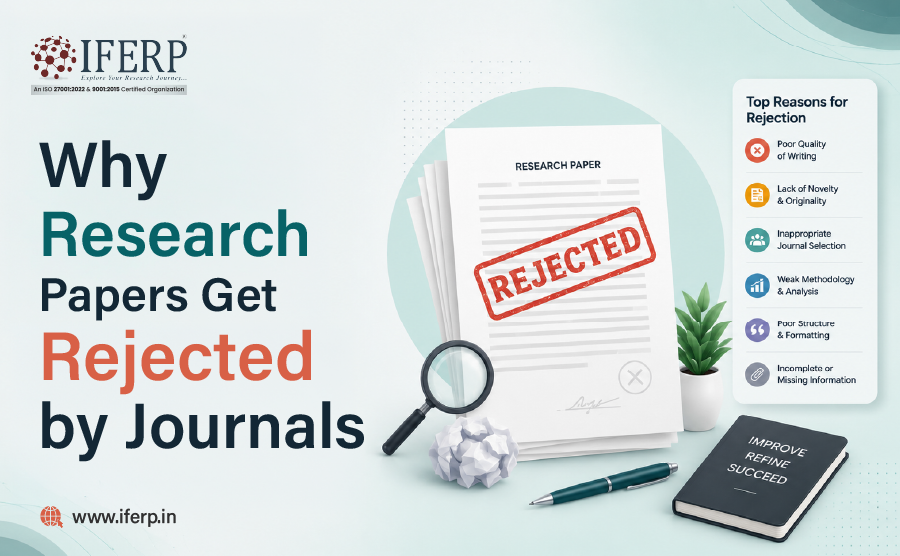
Research paper rejection happens due to poor quality of research, lack of scope of the journal, plagiarism, ineffective methodology, issues in language and formatting, and non-compliance with publication standards.
Getting rejected by a journal can be a demoralizing situation, but the reality is that it is normal in academic publishing. Hundreds of journals receive many manuscripts every year, and thousands of them get rejected. Often, it is not the quality of research conducted that leads to rejection, but rather some simple issues that could have been fixed in advance.
In this article, we discuss the reasons why research papers get rejected as well as share tips on how to avoid such issues.
What Happens After You Submit a Research Paper?
After the submission of your paper, the journal editor will conduct an initial editorial screening. The main purpose of this is to determine if the manuscript fits into the basic requirements of the journal in terms of scope and submission instruction compliance. The editor also reviews the paper for formatting, plagiarism, language quality, compliance with ethical standards, and completeness.
If any of the requirements are missing, the paper will be rejected at an early stage without review by the appointed experts.
Upon passing the editorial assessment, the manuscript moves to the peer review process. The editor assigns a manuscript to the independent experts in the relevant area who check the originality of the paper, research methodology, data analysis, research results, discussion of the results, citation list, and overall quality of the research carried out. Following the evaluation, the experts give complete feedback with recommendations for further actions regarding the manuscript.
Based on the reviewer’s feedback, the editor then makes the final editorial decision. The article can either be accepted with minor modifications, deferred with more extensive changes, or rejected altogether.
Types of Journal Rejections
Research paper rejection comes with different implications depending on its type. Knowing which type of rejection you have received can help you understand what to do next – whether to resubmit the paper with changes or make particular revisions before sending your paper to a different journal.
Here are some types of journal rejections:
Desk Rejection
Desk rejection is when an editor dismisses a manuscript before sending it out for peer review. The editor will initiate a desk rejection if your paper is not focusing on the editorial of the journal and does not comply with the journal submission guidelines. Also, if the paper has poor language use or is not original, it faces desk rejection.
Example: If you submit a healthcare research paper to an engineering journal, the editor rejects it before sending it to reviewers.
Rejection After Peer Review
This kind of rejection happens after receiving evaluation from impartial reviewers who look through your article. In their evaluation, the reviewers point out major flaws in methodology, lack of data, unsupported conclusions, and limited contribution of the research.
Example: The reviewers believe that the sample size is too small to accept the study’s conclusions and advise rejection.
Conditional Rejection
A conditional rejection signifies that the journal is not ready to accept your paper’s present version. But you can resubmit it later with some modifications. It is different from a complete rejection since the revised document will normally go through another reviewing process.
For instance, the editor asks for improvements in the literature review, stronger discussion, and inclusion of recent references in the revised manuscript.
Major Revision Before Reconsideration
In this situation, the journal is confident about the merit of your submission but advises you to make major changes prior to making any decision about publishing your paper. You must comprehensively respond to all comments made by the reviewers and submit a revised paper for evaluation.
Example: The reviewers have requested additional data analyses, clearer methodology description, and improvements to the discussion portion of the paper before it can be put up for publication assessment.
Top Reasons Why Research Papers Get Rejected
Here are the top reasons for research paper rejection:
Reason 1: Poor Research Quality
If your research paper does not satisfy the requirements of quality, the chances are high that it will get rejected during the editorial screening or peer review process. This happens when the study has poorly defined objectives, which fail to define the purpose of the research.
Moreover, a poor methodology such as ineffective design or sample size, and unethical methods reduces the reliability of your research. Furthermore, conclusions that are not substantiated with findings or data reduce the chances of acceptance of the manuscript.
Reason 2: Journal Scope Mismatch
Your manuscript may get rejected by a journal if it is inconsistent with its aims and scope. This happens when the research subject is outside the disciplines covered by the journal or if the article is targeted at an incorrect audience.
Most authors often select the wrong journal because they don’t invest time in understanding the scope of the journal and reading its previously published articles. It is important to select a journal that matches your research area and audience in order to maximize the chances of journal publication.
Reason 3: Plagiarism and Ethical Issues
Plagiarism and ethical violations are one of the main reasons for your manuscript rejection. Journals reject manuscripts for duplicate publication, which means submitting the same work to several journals, including Scopus indexed journals. Or, sometimes you simply copy from already published papers without citations and add new studies to them.
Citation manipulation becomes the reason for rejections. It involves placing unnecessary citations, which is also unethical. Besides, ethical approval for studies involving humans and animals is necessary; without this approval, rejection is likely to happen.
Reason 4: Weak Abstract and Title
The title and abstract are your paper’s calling cards. A title that is not specific enough may not let the reader know what the paper is about. At the same time, an abstract that is poorly phrased may fail to give enough detail about the research objectives and outcome.
So, if your title and abstract are not appropriate, your paper may get rejected. Also, absent keywords or mismatched keywords decrease the paper’s visibility among editors and researchers.
Reason 5: Poor English and Grammar
Language quality is important for the paper evaluation. Errors in grammar, spelling, and punctuation make the paper difficult to read and understand for reviewers. This affects the overall readability of the paper, and it may get rejected.
Reason 6: Formatting Errors
Many journals reject manuscripts for not following the required submission format. Violating author guidelines, misusing a citation style, or forgetting significant segments such as conflict of interest/acknowledgement can cause delays in the review process and or outright rejection. By following the guidelines before the manuscript submission, one can prevent such avoidable errors.
Reason 7: Weak Literature Review
A good literature review reflects your understanding of existing research. Old references can result in a low level of relevance of your research in addition to an inadequate number of citations, which can undermine the academic foundation of your work. To avoid citation-related issues, you may take the help of citation booster services.
Reason 8: Poor Data Analysis
Effective interpretation of data is of utmost importance in generating valuable research outcomes. Despite your research being genuine, minimizing errors in analysis and interpreting results meaningfully while showing some evidence is vital in improving your credibility and having a universal effect on a review of your paper.
Reason 9: Inadequate References
Good citations are important for confirming the reliability of your research, whereas incorrect citations deny the integrity of the research and may result in failure during review stages.
Reason 10: Failure to Address Reviewer Expectations
A manuscript could be turned down if it does not satisfy the requirements of the reviewers and editors. An unconvincing discussion that does not reveal the importance of the results, a small contribution to research that does not add considerable knowledge to previously existing findings, or low novelty with no distinct original results can diminish the chances of publication. The importance, originality, and effect of your research should be clearly described to make your manuscript stronger.
How Editors Evaluate a Research Paper
Before they use the editorial process for a paper, they must thoroughly check the article for acceptance in the journal. They generally check the following items:
- Originality: The editors check if the paper brings some new ideas to the field of research.
- Significance of research: They evaluate the significance of the paper and whether it adds any contribution to people’s understanding of the issues discussed.
- Methodology: They check if the research design, methodology, sample size, data collection, and data analysis used are appropriate for the exploratory study.
- Writing quality: They evaluate the quality of writing in the manuscript, including grammar, structure, and style.
- Ethical compliance: Editors check the manuscript for ethical compliance, personal interests, and originality.
- Appropriateness for the journal: They check how relevant the article is for the journal.
Common Mistakes First-Time Authors Make
Many first-time researchers make mistakes that they could easily avoid, leading to poor acceptance rates in journals. The following are the most frequent mistakes:
- Choosing an unsuitable journal: When one submits their paper to a journal with which it bears no relation, the chances of rejection are high.
- Submitting the paper without editing: Authors must ensure that their grammatical errors, unclear sentences, etc. do not reduce the readability of the text. You can also choose manuscript editing services to reduce rejection.
- Disrespecting the formatting instructions: Journals have certain author guidelines regarding formatting, referencing, tables, figures, and the structure of manuscripts, which, if disregarded, can lead to research paper publication delays or failures.
- Drafting a poor cover letter: Attach a generic cover letter that does not outline what is important about your research and includes incomplete information about it.
- Forgetting to include necessary documents: Not submitting a complete set of documents and forgetting such documents as an ethical approval document, a cover letter, or a statement of no conflict of interest will influence the review period.
- Weak research question development: Poorly formulated questions are not specific, unique, or important; hence, the research is unable to reveal the significance of the research.
- Ignoring journal indexing: Not confirming whether or not a particular journal is included in reliable databases like Scopus, Web of Science, or UGC CARE could lead to a publication in a low-quality journal or a journal with no indexing.
What to Do After Research Paper Rejection
Being rejected by a journal does not mean that your research is worthless. Rather than feeling disheartened, check the comments made by the reviewers to improve your manuscript. Here is what you can do after journal rejection:
Check the comments: Read every comment of editors and reviewers carefully to know the reason for rejection. Try to understand how to improve your manuscript as per the comments.
Understand missing issues: Assess whether the reasons for your rejection are related to the quality of your research, methodology issues, the scope of the journal, writing and formatting issues, ethical issues, or insufficient originality.
Make revisions: Go through the comments provided by the reviewers word by word and make necessary changes to the abstract, title, methods, conclusions, and rest of the parts of the manuscript.
Enhance the research: Make your paper better by including recent references, improving the data analysis, making your points clearer, and ensuring your conclusions are backed by evidence.
Find another appropriate journal: In case your paper is not suitable for the previous journal, choose another journal that meets your paper in terms of aim and scope, audience, and other important aspects.
Resubmit in an ethical manner: Before resubmitting your work, ensure that you have thoroughly gone over it. This includes complying with the new requirements and guidelines outlined by the journal and drafting your letter on a professional level.
Note: If needed, you can take the help of publication support services before submitting to increase your chances of acceptance.
Conclusion
Now, you know the reasons for research paper rejection and how you can avoid them, so follow the tips to increase acceptance chances. Focus on journal scope, research quality, submission guidelines, and ethical practice. For help, you can approach IFERP, which provides publication support to improve your acceptance chances. In addition, you can submit a paper at an international conference 2026 for peer review before submitting it to a journal.
FAQs
Why do journals reject research papers?
When there are issues with the title, abstract, originality, formatting, research scope, methodology, and grammar, journals reject papers. Understanding the journal rejection reasons can help you improve your manuscript before submitting it again.
What is a desk rejection?
A desk rejection is when the journal editor rejects a manuscript before sending it for peer review. The main reason for this mismatch is the journal’s scope and your research subject.
How can I reduce the chances of journal rejection?
Choose the right journal, follow the author guidelines, proofread your manuscript, ensure your research is original, and consider pre-submission research editing services. All this can significantly improve your acceptance chances.
Can I submit the same manuscript to another journal after rejection?
Yes, you can submit your manuscript to another journal after it gets rejected. Make sure to address the review comments from the rejected journal to increase your chances of acceptance in the new journal.
Can plagiarism cause immediate manuscript rejection?
Yes, using someone’s work without citations or new additions is unethical practice. Journals have strict publication ethics and use plagiarism detection software to check your manuscripts. Any form of plagiarism can lead to immediate manuscript rejection.
How important is choosing the right journal?
Selecting the right journal is one of the most important steps in the publication process. A journal that matches your research topic, scope, and target audience increases the likelihood of acceptance.
How long does the journal review process usually take?
The review process usually takes 4 to 12 weeks, but it can vary depending on the journal, reviewer availability, and the number of revisions required.
Can professional manuscript editing improve my chances of journal acceptance?
Yes, professional editing services help improve language quality, readability, grammar, and formatting. Although it does not guarantee acceptance, it can improve chances of acceptance.
Editing & Proofreading Services
Build Your Academic CV with IFERP AI Resume Builder
Scopus Indexed Conferences 2026
-
9th International Conference on Multidisciplinary and Current Educational Research (ICMCER)

-
9th International Conference on Recent Trends in Multi-Disciplinary Research (ICRTMDR)
-
50th World Conference on Applied Science, Engineering & Technology (WCASET)
-
9th International Conference on Dentistry and Oral Health (ICDOH-2026)
News
- Siddth Jain and Rudra’s IFERP is Empowering a Global Research Community
- From Idea to Funding: IFERP's Guide to Successful Grant Applications
- Protecting Researchers: IFERP’s Guide To Identifying And Avoiding Hijacked Journals
- The Power of Networking: How IFERP memberships open doors to global opportunities for universities
- IFERP bridges academia and industry for global sustainability
- Ballot Education Project takes center stage: Bridging theory and practice at International Conference
- IFERP Spearheads Global Sustainable Development Through Research & Innovation