
Common Submission Mistakes That Lead to Instant Rejection
 July 30, 2026
 Journal and Publication, Journal Publication, Manuscript Editing Services
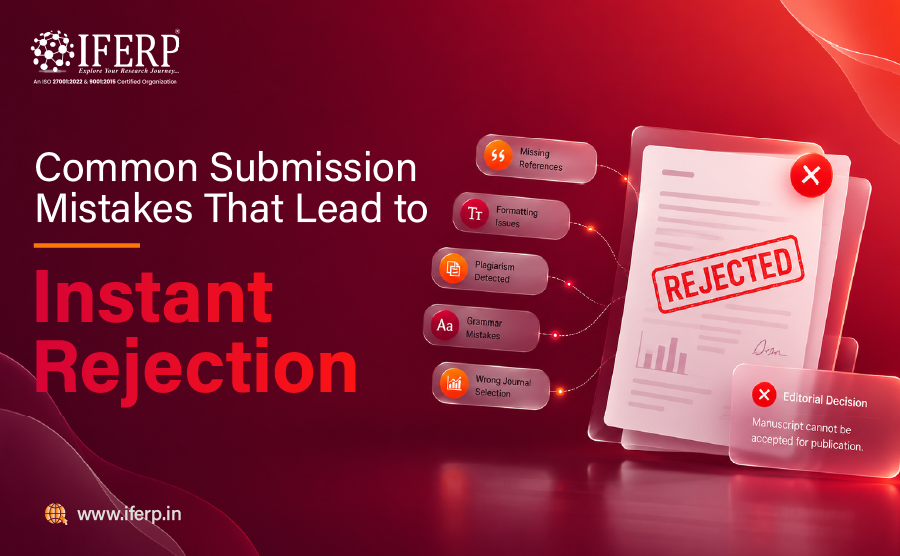
Many journal submission mistakes can lead to rejection of a journal submission even before the manuscript is sent for peer review. More often, the problem is not in poor research. It stems from mistakes that could have been avoided, such as submission to an unsuitable journal, ignoring the submission requirements, or submitting an incomplete document.
In this article, we will discover the most common mistakes that lead to desk rejections of research papers.
An instant, or desk rejection, refers to a situation in which a journal editor rejects a manuscript before it goes for peer review. In the process of the first editorial screening, editors need to check whether:
- The manuscript is relevant to the journal.
- It meets the instructions for authors.
- It follows the ethical standards and whether the research is presented properly.
Unlike peer review rejection, which happens on the basis of expert opinion, desk rejection is an editorial decision.
Why Do Journals Reject Manuscripts Before Peer Review?
The most common reasons journals reject manuscripts before peer review are non-conformity with journal guidelines, uncoordinated research goals, inadequate language, problems with referencing and citation, formatting issues, ethical concerns, or failure to make a meaningful contribution to the field of study.
It is possible that editors’ decisions are also based on whether or not the research is in line with the interests of the journal, its available space for publication, and suitability of the manuscript for the target audience of the journal.
Top 15 Common Journal Submission Mistakes That Lead to Instant Rejection
The most common mistakes that lead to desk rejection of a manuscript include the following:
1. Selecting the Wrong Journal
Choosing an inappropriate journal for your study is the quickest way to get rejected by a journal. Editors check first whether the subject, research method, and readership correspond with the journal’s profile. Even if the paper is written correctly, it can be rejected because it is outside the journal’s scope.
2. Not Reading the Instructions to Authors
Ignoring provided submission guidelines is an indication of a lack of preparation. Editors want all the submitted papers to correspond to this format, word limits, and style of referencing. Minor mistakes would result in extra work and immediate rejection.
3. The Study Lacks a Clear Research Aim
If the purpose of the research, research question, or hypothesis is not clear enough, then the article becomes vague. You should state your research goal at the beginning of the introduction.
4. No Proper Abstract
The abstract is usually the first section that is read by most editors. So, it should be written to convey the importance of the research clearly. A poor abstract may miss important aspects of the research work, such as the research objective, methods of research, major findings, or conclusions.
5. Poor English and Grammar
Bad quality language makes even good research work difficult to understand. While poor grammar, awkward sentences, and inconsistent terminology may undermine confidence in the article, a good revision and editing process may solve this problem.
6. Poor Plagiarism Score
A high similarity score can make anyone think of research integrity. This includes direct copying, self-plagiarism, duplicate journal publication, and missing citations. Most journals screen every manuscript submission with plagiarism software before forwarding to peer review.
7. Missing References
When references are outdated, missing, or simply incorrect, it tends to weaken the article and raise doubts about the ability of the researcher. Editors may also see discrepancies between the references and the citations. Therefore, every citation should be verified very well. Also, the latest addition relevant to the research work should be provided when necessary.
8. Poor Literature Review
A literature review is expected to explain what is already known and address the gap in previous studies. It’s not enough just to list previous research work without an explanation. Editors expect a systematic discussion which includes current research in connection with your research.
9. Inappropriate Research Design
The editors seek a methodology that is clear, suitable, and replicable. Omissions in details such as the process of data collection, sample size, analysis method, and validity of the study will lessen faith in your findings.
10. Mistakes in journal formatting
Formatting mistakes may seem small, but they are evidence of the author’s carelessness. Mistakes in headings, typeface and fonts, tables, and referencing styles can lengthen the editorial board’s revision process.
11. No ethical approval
Research involving humans, animals, or sensitive data often requires approval from an ethics board. If the writer has no ethical approval, this implies an immediate rejection of the manuscript. The required ethical statement needs to be added whenever the journal requests it.
12. Low Quality Tables and Figures
Poor resolution of the illustrations, unclear labels, inconsistent numbering, and badly-designed charts make the work difficult to judge properly. Use high-quality illustrations and follow the technical requirements of the journal when designing them.
13. Missing Submission Documentation
Many journals require not only a manuscript. Missing documents such as a cover letter, conflict of interest statement, author contribution statement, ethics declaration, and supplementary files can delay the editorial process or even lead to rejection. Make sure you prepare every document you will need before research paper submission.
14. Skipping Proofreading
Submitting a manuscript without final proofreading often results in spelling mistakes, formatting errors, broken references, and factual inaccuracies. Avoidable mistakes give a bad impression. Leave the manuscript for a day and proofread it afterward, or ask someone else to review it.
15. Ignoring Reviewer or Editor Comments During Resubmission
Editors expect authors to respond to every suggestion and explain their decisions. A good response letter and an edited manuscript demonstrate professionalism and are likely to lead to positive outcomes.
How can you Avoid Instant Journal Rejection?
To avoid automatic rejection, you must prepare in advance and carefully before manuscript submission.
- Choose a journal that matches your subject.
- Read the journal’s rules thoroughly and follow all requirements.
- Check your manuscript for clarity. If necessary, use professional manuscript editing and publication support services.
- Check for originality and make sure all sources are referenced properly. Also, be sure that your references are complete.
- Check that your figures and tables are in accordance with the journal’s requirements.
- If your study requires ethical approval, include the necessary declarations and supporting information.
Before research paper submission, ensure that all the necessary paperwork is prepared, which may include a cover letter, conflict of interest form, statement of author contribution, among others that the journal may require.
Journal Submission Checklist
- Manuscript is prepared for submission.
- Journal scope fits your research topic.
- Formatting matches the journal guidelines.
- References are complete.
- Figures and tables meet the standards.
- Plagiarism checks and grammar checks were conducted.
- Cover letters and supporting documents are prepared.
- Ethical approvals and declarations were included if necessary.
- All submission files were reviewed.
- Final proofreading checks were completed.
Pre-Submission Quality Control Tips
An appropriate quality check helps avoid the loss of simple mistakes that are usually ignored during the writing process. Before submitting the manuscript, do not forget to apply some common suggestions like the following:
- Use a journal submission checklist instead of relying on memory.
- Reach out to a supervisor or a colleague and ask them to read your manuscript before submitting it.
- Make sure to read the journal’s policies and check whether your paper meets all expectations.
- Confirm that each in-text citation is present in the reference list.
- Double-check the accuracy of calculations, data, figures, and tables.
- Verify that all supplementary materials, as well as important documents, are present in the submitted manuscript.
- Make one last proofreading before submission.
- Pre-submission peer review can be very helpful in identifying and fixing flaws, clarity, originality, and plagiarism in a manuscript.
Common Myths About Journal Rejection
Many researchers do not understand the reasons why journals reject a manuscript. Separating myths from reality can help you prepare a stronger submission.
| Myth | Reality |
| Only poor research gets rejected, | Even research of high quality may get rejected if it does not meet the author’s guidelines or fits the journal’s scope. |
| Publishing in a high-impact journal guarantees acceptance. | The quality of a manuscript is what matters regardless of its impact factor. |
| Formatting does not matter that much. | Formatting may be evaluated at the first stage of editing. |
| Editors are interested only in research quality. | Editors also pay attention to ethical compliance, language, quality, and completeness of the documents. |
Benefits of Proper Manuscript Preparation
Preparing a high-quality manuscript creates a good situation for a submission and increases the probability of approval by editors.
Some of the key benefits include:
- A positive first impression.
- Speed up the editorial screening process.
- Reduction of technical revision requests.
- Higher quality of the manuscript.
- Understanding of the journal’s requirements.
- Confidence during the submission process.
Conclusion
Usually, most mistakes in journal submissions can be avoided with planning. An appropriate choice of journals, following the writing style, checking the journal’s policy, reviewing the bibliography, and making all necessary documents may considerably improve the chances for publication. Before research paper submission<, a researcher should review the manuscript from the perspective of an editor.
Reach out to IFERP for publication support services with Scopus-indexed journals, SCI and SCIE journals. If you are planning to attend an international conference in 2026, subscribe with us to get customized conference alerts.
FAQs
1. What are the most common journal submission mistakes?
Common mistakes made while submitting to journals include choosing the wrong journal, failure to follow the manuscript preparation requirements, poor abstract writing, formatting issues, lack of references, language mistakes, reluctance to properly cite references, and missing documents.
2. What is an instant or desk rejection in journal publication?
Desk rejection refers to an activity commonly performed by editors when they get rid of papers without subjecting them to formal review. It takes place when, for various reasons, the manuscript is not in compliance with the submission rules of the journal.
3. Can formatting errors lead to journal rejection?
Yes. A paper may be rejected if just one formatting error occurs and the author does not follow the journal standards. Using the required format is indicative of the author’s professionalism.
4. How can I avoid desk rejection before peer review?
Select a journal suitable for your research, follow the author guidelines, proofread your article, avoid plagiarism, cite your sources properly, and include all the documents required for submission.
5. Does plagiarism always result in journal rejection?
Yes, it is common practice to conduct plagiarism screening on all manuscripts submitted to journals. High similarity indexes, duplicate submissions, self-plagiarism, or lack of citations can result in automatic rejection of the manuscript.
6. Why is choosing the right journal important?
Proper selection of journals increases the likelihood of getting your manuscript considered for peer review. Manuscripts that match the goals of a certain journal are more likely to be considered seriously by the editorial board.
7. What documents are required for journal submission?
Requirements vary by journal, but most ask for a cover letter, conflict of interest statement, author contribution statement, ethics declaration where applicable, supplementary files, and the manuscript itself.
8. Can professional editing improve my manuscript before submission?
Yes, using a professional editing service can help you improve grammar, clarity, consistency, and the general readability of the manuscript. This guarantees the text of the research work is appropriately formatted and reduces the level of language barriers.
9. Should I get a pre-submission peer review before submitting my paper?
Yes. Pre-submission review by the supervisor, colleagues, or an expert in the area is essential to spot the weak spots that may easily be missed at first sight.
10. What should I do if my manuscript is rejected?
Pay attention to the editor’s comments and find out the grounds of rejection. Improve your manuscript accordingly, and think about resubmitting it to another appropriate journal if it still fits your study.
Editing & Proofreading Services
Build Your Academic CV with IFERP AI Resume Builder
Scopus Indexed Conferences 2026
-
9th International Conference on Multidisciplinary and Current Educational Research (ICMCER)

-
9th International Conference on Recent Trends in Multi-Disciplinary Research (ICRTMDR)
-
50th World Conference on Applied Science, Engineering & Technology (WCASET)
-
9th International Conference on Dentistry and Oral Health (ICDOH-2026)
News
- Siddth Jain and Rudra’s IFERP is Empowering a Global Research Community
- From Idea to Funding: IFERP's Guide to Successful Grant Applications
- Protecting Researchers: IFERP’s Guide To Identifying And Avoiding Hijacked Journals
- The Power of Networking: How IFERP memberships open doors to global opportunities for universities
- IFERP bridges academia and industry for global sustainability
- Ballot Education Project takes center stage: Bridging theory and practice at International Conference
- IFERP Spearheads Global Sustainable Development Through Research & Innovation