
How to Publish a Research Paper
 July 23, 2026
 Publish Research Paper, Research Paper, research paper publication
Research paper publication is a great way for scholars, students, and faculty members to achieve academic and professional growth. Being published in a reputable journal brings global visibility, credibility, and recognition to you and your work.
And a successful journal publication starts with careful planning, high-quality, original research, and selecting an appropriate journal.
If you want to publish a research paper in a legitimate journal—whether as a research Scholar, professor, master’s student, academic author, or an early-career researcher—this guide is for you.
We will walk you through easy, actionable steps to publishing a research paper, finding a journal that best matches your manuscript’s scope, and common mistakes you must avoid.
What Is a Research Paper?
A research paper is a scholarly work meant to investigate a specific problem, review relevant literature, gather and analyze data using appropriate methodology, and draw conclusions supported by credible evidence. Finally, the findings are communicated by presenting at an international conference and publishing in a journal.
Different types of research papers include:
- Original Research
- Review Articles
- Case Studies
- Short Communications
- Conference Papers
Why Publish a Research Paper?
Publishing a research paper facilitates academic recognition, increased visibility, knowledge exchange, and career growth opportunities.
Academic Recognition: Publishing your work in reputable journals like Scopus-indexed journals establishes your credibility, grows your network, and drives career growth.
Career Advancement: Recognition opens doors to new opportunities for partnerships, funds, and overall career advancement.
Knowledge Sharing: By publishing your work, you contribute your knowledge to your discipline. It can help inform future studies and contribute to the development of new ideas and theories.
Higher visibility and citation opportunities: Publishing brings exposure to your work, which can translate into more citations and greater visibility. Don’t forget to promote your work online, via regular bulletins, and other channels to increase citations, which is a key metric employers and funders measure how you stack up.
Collaboration and Networking: Published work brings collaboration opportunities with other researchers and investors who might be interested in your work. This allows you to further your research and accelerate progress.
Step-by-Step Guide to Publishing a Research Paper
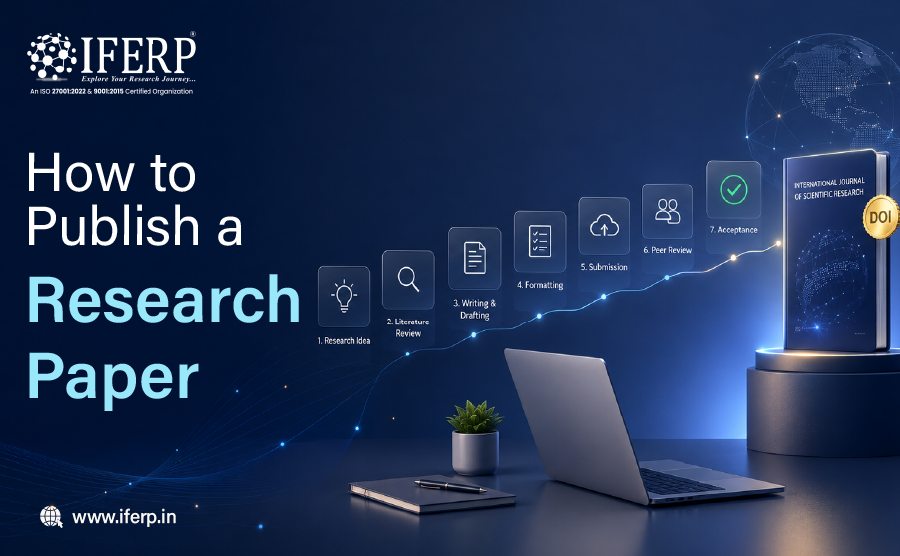
Publishing a research paper involves 10 key steps, starting from finalizing your research topic to publishing. Let’s discuss each step one by one:
Step 1: Choose a Research Topic
- List the top three areas in which you actually care.
- Check academic databases to make sure there are enough recent sources.
- Measure uniqueness—a gap that you can fill.
- To settle the topic, use the FINER acronym (Feasible, Interesting, Novel, Ethical, Relevant).
Step 2: Conduct a Literature Review
A literature review refers to a critical and systematic analysis of existing research on your topic. This includes examining existing books, academic articles, conference papers, and other relevant sources to identify key themes, methodologies, and research gaps.
Key steps involved in literature review:
- Identify the literature
- Perform critical analysis
- Categorize your resources
- Consult with your instructor, advisor, or mentor
- Iterate as needed
Step 3: Prepare Your Research
As you proceed with your research, start with identifying and defining your key objectives. Select an appropriate methodology, whether qualitative, quantitative, or mixed methods. Lastly, ensure you collect the needed data through appropriate methods and analyze it thoroughly.
Step 4: Write the Research Paper
Key sections to include in research paper writing:
Title: The paper’s title, the author’s name, and the date.
Abstract: A broad overview of the paper in 100-300 words (not longer than one page)
Introduction: States the main research problem, thesis argument, and study’s purpose
Literature Review: Discussion or review of existing knowledge of your topic.
Methodology: Methods you used for the study: qualitative or quantitative methods, surveys, interviews, and analysis approaches.
Results: The longest part where the author supports the thesis and builds the argument using the data collected and existing material.
Discussion: A summary of the results, how those results address the topic, and implications of those findings.
Conclusion: Summarizes the main idea and thesis, giving the readers a sense that the paper’s goal has been achieved.
References: List of books, articles, and other materials cited. References should follow specific APA guidelines regarding author names, dates, article titles, journal titles, journal volume numbers, page numbers, book publishers, and so on.
Step 5: Edit and Proofread
Once the manuscript is ready, it’s time to proofread and edit as required. This is one of the most important steps. You have to read your paper for grammar, language quality, formatting, reference checking, and plagiarism.
Read your paper 2-3 times, or ask a colleague or peer to proofread it for you. If required, don’t hesitate to hire professional manuscript editing services as they can enhance the clarity, flow, and credibility of your writing while ensuring your paper is error-free.
Step 6: Journal Selection
Choosing an appropriate journal is essential for enhancing your chances of getting published. First, check if the journal is within the scope of your study and if it reaches out to your target audience.
Then check whether the journal is indexed in reliable scientific databases like Scopus, SCI, SCIE, or Web of Science. Finally, analyze the publication procedures, acceptance rate, and author requirements before submitting your manuscript.
Step 7: Prepare Submission Documents
Gather all necessary documents before submission to avoid potential delays in the review process. These documents usually include a cover letter, title page, conflict of interest statement, copyright form, and any necessary ethical approval documents if your study includes human or animal subjects. Be sure to strictly adhere to the journal’s submission requirements and checks for completeness and formatting.
Step 8: Manuscript Submission
Most journals use an online submission system that makes submission easier for authors. Be sure to upload your paper along with any documents that are needed to support your submission. Once everything has been uploaded, do not forget to save the confirmation email containing the unique tracking number for your manuscript.
Step 9: Peer Review Process
Upon submission, the manuscript goes through an editorial evaluation to determine if the paper is suitable for the journal. The journal will perform a desk rejection on submissions that do not comply with minimum requirements. Acceptable manuscripts move to the peer review process, where experts assess the manuscript quality. Based on the opinions of these reviewers, the paper might be required to undergo some minor or major changes before approval or rejection.
Step 10: Journal Publication
After your paper is accepted, you’ll receive an acceptance letter and will be asked to provide any needed proof corrections. Your submission is given a DOI after it is accepted. It will then be published. Following that, it is included in indexing systems like Scopus or Web of Science to make our paper discoverable.
How to Choose the Right Journal
Appropriate journal selection is important to maximize the chances of having your article published in it. Find an appropriate journal whose scope matches your field of research and audience. Make sure the journal is recognized and indexed in scientific databases like Scopus, Web of Science, SCI, and SCIE.
Review the journal’s author instructions and the regulatory guidelines followed to write and submit a manuscript. Check the publication cost to ensure that the payment can be made without hindrance. Finally, evaluate the journal’s characteristics and reputation by analyzing its peer review process and editorial board.
Common Reasons Research Papers Get Rejected
Your research paper may get rejected due to poor research quality, weak methodology, wrong journal, grammar or formatting issues, and so on.
Keep these mistakes in mind so you never make them:
- Poor research quality
- Weak methodology
- Journal scope mismatch
- Poor English
- Plagiarism
- Formatting errors
- Weak literature review
- Lack of originality
- Ethical issues
- Incomplete references
Tips to Improve Journal Acceptance
You can improve your chances of journal acceptance by choosing the right journal and strictly following author guidelines. Maintaining manuscript quality and responding to reviewer comments professionally can also increase the likelihood of passing the editorial stage.
Key tips to boost journal acceptance:
- Choose the right journal
- Follow author guidelines
- Improve manuscript quality
- Conduct plagiarism checks
- Use professional editing
- Strengthen the literature review
- Write a strong abstract
- Respond professionally to reviewer comments
Common Mistakes First-Time Authors Make
Many first-time authors make mistakes that can delay publication or even get them disqualified. By understanding some of these typical errors, a writer can increase the chances of their writing being accepted.
Wrong journal selection: Sending a manuscript to an unsuitable journal for its content and purpose leads to rejection instantly.
Disregarding submission guidelines: Ignoring the journal’s proper style and format can hinder the review process and lead to rejection.
Bad formatting: Improper style, poor citations, etc., give a wrong impression to the editor and reviewers.
Weak cover letter: A generic or incomplete cover letter may not effectively highlight your study’s significance and originality.
Submitting without revising: Many mistakes in the writing show low professionalism in the document. Also, plagiarism is a major breach.
Missing documents: Omitting necessary documents, including title pages, approvals, and a statement regarding conflict of interest, can lead to the journal reviewing a writer’s work.
For first-time research paper authors, we strongly recommend working with reliable publication support services. Their professional assistance helps save time, avoid desk rejections, and increase acceptance rates.
Research Paper Publication Timeline
Research paper publication timelines differ significantly across journals and disciplines. The table below shows standard timelines for various stages involved in the process:
| Stage | Estimated Timeline |
| Research & Writing | Weeks to months |
| Manuscript Editing | Few days to 2 weeks |
| Journal Submission | 1 day |
| Editorial Screening | 1–3 weeks |
| Peer Review | 1–6 months (varies by journal) |
| Revisions | Depends on reviewer feedback |
| Final Publication | Varies by journal |
Pre-Submission Checklist
- Research completed
- Original contribution demonstrated
- Journal selected
- Manuscript formatted
- References verified
- Grammar checked
- Plagiarism checked
- Cover letter prepared
- Supporting documents attached
- Final review completed
Conclusion
Before submitting a manuscript for publication, a researcher must complete the research process, write a quality paper, and choose an appropriate journal for manuscript submission. When publishing an article, proper procedures and mechanisms must be followed to maximize the chances of publication and ensure that the published work is widely recognized by the public. Join IFERP to stay updated with upcoming conferences and journal publication opportunities in your niche.
FAQs
How do I publish a research paper for the first time?
To publish a research paper for the first time, write a high-quality and original research paper. Submit it to an appropriate peer-reviewed journal and make sure your manuscript follows the journal’s guidelines.
How long does it take to publish a research paper?
Publishing a research paper is a lengthy process, especially if you are publishing in a reputable journal. It typically takes 4-8 months, or even longer. So, have patience and keep monitoring your email for any notification.
Can students publish research papers in journals?
Yes, many reputable peer-reviewed journals accept research papers from students. Journals consider the quality of research rather than the author’s age and qualifications.
How do I choose the right journal for my research paper?
Choose a reputable journal that matches the scope of your manuscript. Also, consider indexing, such as Scopus-indexed journals that are reputed for rigorous peer review and high academic standards.
What documents are required for journal submission?
Documents required for journal submission include your manuscript, a main document file with abstract, keywords, main text and references, figure files, table files, and any extra files like supplemental materials or biographical notes.
What is the peer review process?
The peer review process is a quality assessment conducted by independent experts before a research paper is published. Reviewers evaluate the manuscript’s quality and provide feedback for improvement.
Why do journals reject research papers?
Poor research quality, weak methodology, wrong journal selection, poor English, plagiarism, poor formatting, weak literature review, and ethical issues can lead to research paper rejection.
Can I submit the same research paper to multiple journals?
Submitting the same research paper to multiple journals is unethical. Reputable journals require authors to declare that their paper is unique and is not published anywhere else.
How can I improve my chances of journal acceptance?
Choose the right journal, follow author guidelines, ensure manuscript quality, and write a strong abstract to improve the chances of journal acceptance.
Can I publish a research paper without a PhD?
Yes. Undergraduate students, postgraduate students, independent researchers, and industry professionals can all publish in academic journals without a PhD.
Editing & Proofreading Services
Build Your Academic CV with IFERP AI Resume Builder
Scopus Indexed Conferences 2026
-
9th International Conference on Multidisciplinary and Current Educational Research (ICMCER)

-
9th International Conference on Recent Trends in Multi-Disciplinary Research (ICRTMDR)
-
50th World Conference on Applied Science, Engineering & Technology (WCASET)
-
9th International Conference on Dentistry and Oral Health (ICDOH-2026)
News
- Siddth Jain and Rudra’s IFERP is Empowering a Global Research Community
- From Idea to Funding: IFERP's Guide to Successful Grant Applications
- Protecting Researchers: IFERP’s Guide To Identifying And Avoiding Hijacked Journals
- The Power of Networking: How IFERP memberships open doors to global opportunities for universities
- IFERP bridges academia and industry for global sustainability
- Ballot Education Project takes center stage: Bridging theory and practice at International Conference
- IFERP Spearheads Global Sustainable Development Through Research & Innovation