
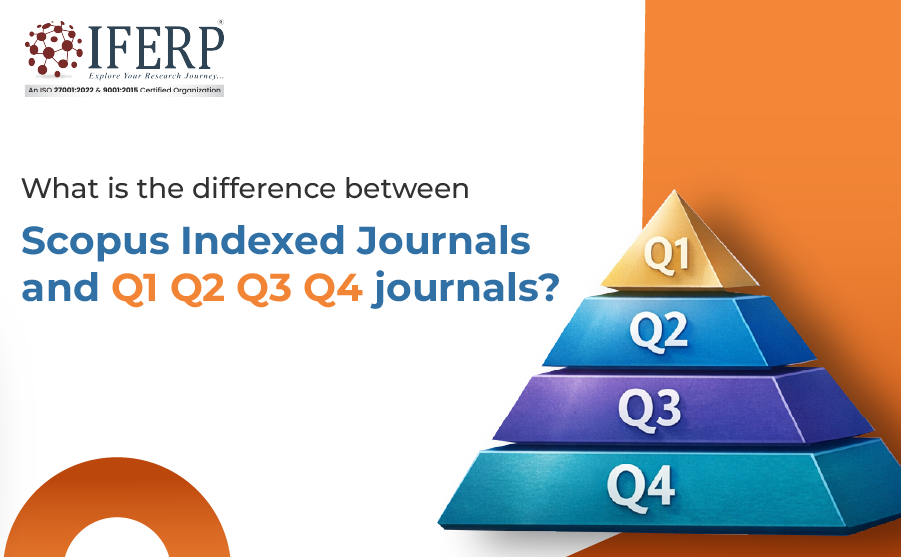
What is the difference between Scopus indexed journals and Q1 Q2 Q3 Q4 journals?
 March 18, 2026
 Journal Publication, Journal Ranking, Scopus Indexed Journals, Scopus Journals
Whether you are a researcher, PhD scholar, or academic professional, everyone wants to publish a paper in a reputed journal. But, choosing a journal is one of the most critical decisions and most authors get confused between terms like scopus indexed journals, scopus journals, and journal ranking Q1, Q2, Q3, Q4.
Many researchers and students think that all scopus indexed journals 2026 are Q1 and Q2, but this is not the case. And, having such a confusion can impact your publication, its citation, and review process. In this article, we will explain to you the difference between Scopus indexed journals and Q1 Q2 Q3 Q4 journals.
How Are Journal Quartiles Determined?
There are few factors that decide the quartiles of a Scopus indexed journal. Here are some of them:
- Number of citations a journal received
- The quality and reputation of citing journals
- Comparison based on subject
- Prestige of the source journals
Quartile ranks are always within subject: the journals in one discipline compete only against each other, so that a journal is either judged superior or otherwise to the others (of its kind). And the prestige and influence of the journal as a whole are taken into account, often based on metrics such as CiteScore or SJR. The most critical issue is that, a journal (if not already indexed by Scopus), has first to be indexed by Scopus before it could get assigned with a quartile rank, as the quartiles belong only for journals existing in Scopus. A journal must first be a scopus indexed journal before it can be ranked into journal ranking Q1, Q2, Q3, Q4.
Difference Between Scopus Indexed Journals and Q1 Q2 Q3 Q4 Journals
A scopus indexed journal is a journal that has been evaluated and approved for inclusion in the Scopus database. Also, Scopus assesses journals against the highest standards of editorial quality, peer-review integrity, ethics, and professional practice. After acceptance, the journal will be indexed in scopus journals where articles are searchable and citable through scopus website.
In any case, being indexed is not the same as a journal’s count or impact-ranking: it just ensures that the journal complies with Scopus standards.
Indexing Status vs Ranking Level
The fundamental difference is that scopus indexed journals indicate whether a journal is included in the Scopus database, while Q1 Q2 Q3 Q4 journals indicate how that journal ranks within its subject area. Scopus index belong to yes or no type and the quartile ranking comes under graduation ranking system to categorize journal by comparison.
Minimum Quality Approval
A scopus indexed journal meets Scopus’s baseline requirements such as peer review, editorial quality, and ethical publishing. On the other hand, Q1 Q2 Q3 Q4 journals list ranked journals according to citation indicators and standing. A Q1 journal is top relative impact, Q4 journals are obviously lower – despite all being Scopus-indexed.
Stability vs Variability
Scopus indexing tends to be relatively stable once a journal is accepted, unless it violates indexing standards. Quartile rankings, however, are not static and can fluctuate annually according to citation data.
A journal can be shifted from Q2 to Q1 as well as downgraded from Q2 to Q3, that is however the same scopus indexed journal. This annual variation made the quartile ranking a more responsive measure to assess journal’s performance.
Scope of Evaluation
Scopus indexing evaluates journals individually, without comparing them to others in the same field. Often journals are ranked against similar journals within a subject category. This means a journal may perform well in one discipline and poorly in another, affecting its journal ranking Q1, Q2, Q3, Q4 status but not its indexing.
Author Strategy and Submission Choice
For authors, the difference affects submission strategy. Selecting a scopus indexed journal confirms credibility, while selecting a Q1-Q4 journal aligns the publication with career goals. When researchers ask which journal is good, Q1 or Q2?, they are weighing prestige against acceptance probability-something indexing alone does not indicate.
All in all, Scopus indexed journals confirm whether a journal is recognized, while Q1 Q2 Q3 Q4 rankings indicate how influential that journal is compared to others.
Let’s understand differences further in tabular form!
| Aspect | Scopus Indexed Journals | Q1 / Q2 / Q3 / Q4 Journals |
| Definition | Journals approved and indexed in Scopus | Ranking decides within Scopus journals list |
| Indexing | Yes | Must already be indexed |
| Quality Indicator | Basic Scopus quality standards | Quality varies from high to low and so the impact factor |
| Classification | No quartile assigned automatically | Classified as journal ranking Q1, Q2, Q3, Q4 |
| Scope | Broad | Subject-specific |
| Example | Any journal in Scopus | Part of Q1 q2 q3 q4 journals list |
| Academic Weight | Moderate | Varies (Q1 highest, Q4 lowest) |
Note: All Q1, Q2, Q3, and Q4 journals are Scopus indexed – but not all scopus indexed journals are ranked Q1-Q4.
How Does the Quartile of a Journal Affect Publication?
Here is how the quartile of journal affect your publication:
Acceptance Rate
The quartile of Scopus journal indicates its competitiveness. Q1, Q2, Q3, and Q4 journals differ from each other both in the terms of submission and in selection criteria. The Q1 journals receive a large number of submissions from authors around the world, and therefore the acceptance rate for such journals is very low.
Q2 is the journals are less competitive but still good, while Q3 and Q4 Scopus indexed journals provide even better odds for the acceptance, with more opportunities for early career researchers.
Peer Review Quality
Quartile ranking is also indicative of the peer review process for each journal. Q1 journals often include several expert reviewers and may need to undergo several rounds of revisions. Q2 and Q3 journals remain committed to structured reviews, but are more flexible now.
Q4 scopus journals, while still peer-reviewed, often apply simpler review criteria that focus on methodological soundness rather than groundbreaking impact.
Publication Timeline and Review Duration
The time from submission to publication of a document is directly linked to the quartile of the journal. Q1 journals often take several months to complete the review and editorial process due to extensive scrutiny.
Q2 and Q3 journals usually provide faster decisions, making them suitable for researchers with moderate time constraints. Q4 journals are often chosen when quick publication is needed, such as for degree completion or institutional deadlines, while still remaining within scopus indexed journals 2026.
Academic Recognition
Quartile ranking plays a crucial role in how publications are evaluated by academic institutions. Many universities, funding agencies, and accreditation bodies rely on Journal ranking Q1, Q2, Q3, Q4 to assess research quality.
But, if you publish in Q1 and Q2 journals, it means there are higher chances in promotions, grants, and performance evaluations. Q3 and Q4 journals carry comparatively lower recognition, but they remain valid entries in the official Q1 Q2 Q3 Q4 journals list and contribute to an author’s research profile.
Research Visibility and Citation Potential
The visibility of a research article increases with the quartile ranking of the journal. Articles published in Q1 journals typically reach a wider international audience and receive higher citation counts. Q2 journals also offer good exposure within specific disciplines.
Q3 and Q4 Scopus journals may not receive as many citations, but they still support researchers in disseminating the work they do in specialized or emerging areas.
FAQs – Scopus indexed journals and Q1, Q2, Q3, Q4 journals
Que: Is it worth publishing in a Q3 journal?
Ans: Yes, publishing in a Q3 journal is worth it. It is a good journal especially for first time authors, new researchers, and early career academicians. Your paper will get recognition when published in Q3.
Que: How to know if a journal is Q1 or Q2 in Scopus?
Ans: You can search the journal’s title of ISSN in the SCImago website, to check if it is listed as Q1 or Q2. It will give you the quartile in which yours fall.
Que: Which is better, Q1 or Q2 journal?
Ans: High impact and visibility is offered by Q1 journals, but Q2 journals are a good trade-off between quality and chances of acceptance.
Que: Is it hard to publish in a Q1 journal?
Ans: No, it’s not hard, but of course your paper needs to meet quality criteria to be published in Q1 journal.
Que: Is the Scopus Q4 good?
Ans: Yes, You can submit your manuscript and publish in Scopus index Q4 Journal. It’s perfect for beginners, niche research or authors who want to get published faster.
Which Journal Should You Choose?
Selecting the right journal is dependent on the quality of your research experience and academic goals. Scopus indexed journals represent credibility and recognition and Journal ranking Q1, Q2, Q3, Q4 displays the journal’s relative position in its category. For example, early career scholars might use Q3/Q4 venues for exposure and gaining experience before submitting to the primarily Q1 or Q2 journals where high prestige and visibility exist.
Editing & Proofreading Services
Build Your Academic CV with IFERP AI Resume Builder

News
- Siddth Jain and Rudra’s IFERP is Empowering a Global Research Community
- From Idea to Funding: IFERP's Guide to Successful Grant Applications
- Protecting Researchers: IFERP’s Guide To Identifying And Avoiding Hijacked Journals
- The Power of Networking: How IFERP memberships open doors to global opportunities for universities
- IFERP bridges academia and industry for global sustainability
- Ballot Education Project takes center stage: Bridging theory and practice at International Conference
- IFERP Spearheads Global Sustainable Development Through Research & Innovation
Join IFERP Professional Membership & Get More Benefits
Recent Blogs
- The End of Single-Discipline Thinking: Why the Future of Research Will Be Built at Platforms Like ICMCER 2026
- What Makes Conferences Worth Attending? Top Reasons Professionals Go
- What is the difference between Scopus indexed journals and Q1 Q2 Q3 Q4 journals?
- What is the difference between an international conference and a Scopus indexed conference?
- What are the Scopus Indexed Journals 2026?