
Step by Step Guide for Publishing in Web of Science Journals
 July 27, 2026
 Journal and Publication, Journal Indexing, Journal Publication, Web of science journal
To publish in Web of Science journals, choose a journal, submit a manuscript, receive feedback, revise the paper, and resubmit. The quality of the study, the originality of the work, the way the content is presented, and the author’s expertise all play a role in publication in a good indexing journal. If you want to publish in Web of Science Index journals and want to know how to publish a work in them, this article is for you.
Here we assist you in finding reputable publications and provide simple instructions for publishing your work in a Web of Science journal.
What Are Web of Science Journals?
Web of Science journals are scholarly journals indexed in the Web of Science Core Collection, one of the world’s leading citation databases maintained by Clarivate. The aim of these journals is to encourage ethical research publishing and assist researchers in staying away from predatory or low-quality journals.
These journals are known for publishing high-quality, peer-reviewed research and are popular among researchers, universities, and funding organizations worldwide. They journals undergo evaluation on basis of:
- Editorial quality
- Peer-review articles
- Publication ethics
- Regular publication
- ISSN registration
- Transparency
- Originality
Benefits of Publishing in Web of Science Journals
- Enhances the reliability, credibility, and quality of your research.
- Increase global visibility by making your work appear in an academic journal search engine.
- Strengthen your profile for promotions, faculty positions, and new research opportunities.
- Build networks with other professionals in your field of knowledge.
- Guarantees that your article is written according to the code of ethics in publishing.
- Creates possibilities for future research and quotations.
For those who are wondering how to increase citations for research papers, can choose to publish in Web of Science journals for visibility and citations.
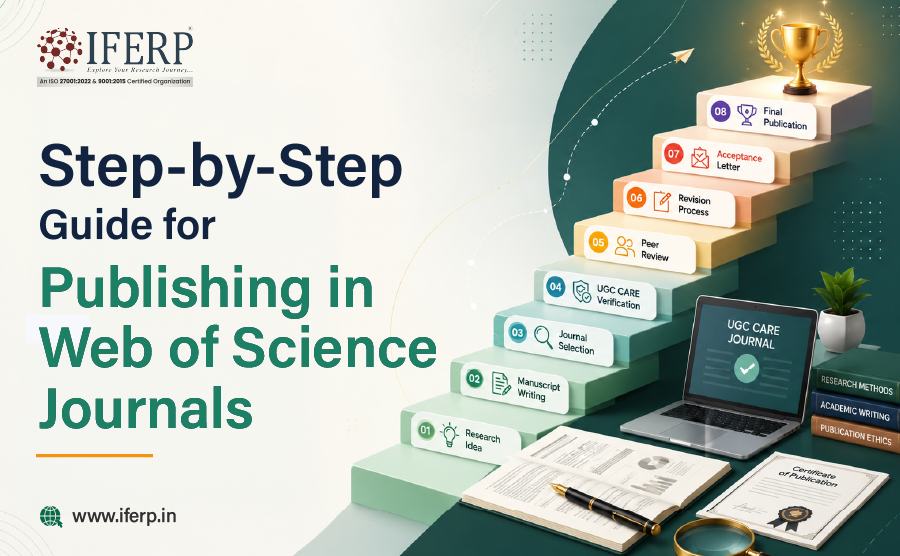
Step-by-Step Guide to Publishing in Web of Science Journals
To publish in Web of Science journals, you need proper planning, manuscript preparation, and journal selection. Here is a step-by-step guide on the journal publication process.
Step 1: Choose the Appropriate Web Of Science Journal
Selecting Web of Science approved journals that are relevant to your research topic is important to avoid rejections. So, check the listed journals in the official Web of Science Master Journal List. If needed, you can confirm it with your professors or previous researchers who published in the same journal.
When choosing a journal, keep in mind:
- Subject pertinence
- The journal’s scope
- Frequency of publication
- Examine the chronology
- Guidelines for authors
- Details of indexing
Step 2: Check the Authenticity of the Journal
You must verify the journal’s legitimacy and current status on the Web of Science database for submission. Check the journal with WoS or official university resources. Also, don’t forget to examine publisher details. Reputable papers offer:
- Details of the editorial board
- Policy for peer review
- The ISSN number
- Publication ethics
- Contact details
- Steer clear of predatory journals
Note: Journals with unrealistic publication promises or dubious websites should be avoided by researchers.
Step 3: Finalize Your Manuscript
After you choose a journal, it’s time to finalize your manuscript according to the publisher’s guidelines. Make sure to choose the correct format, citation style, word limit, and file type described by the publisher. A well-prepared manuscript usually contains:
- Title and abstract
- Keywords
- Introduction
- Literature review
- Methodology
- Results and discussion
- Conclusion
- References
Before manuscript submission, double-check that it for originality, plagiarism, and formatting.
Stage 4: Send in your Research Article
You can send in your research paper using the official website of the selected journal or a manuscript submission system. For most submissions, you need to create an author profile and send in your research article. Also, fill in the necessary details requested during submission and double-check everything before hitting “submit”.
Step 5: Peer Review Process
Once you submit your manuscript, the journal forwards it to peers who will analyze it from several angles. Specialist reviewers will assess your work’s originality, methodology, significance, and overall quality. Depending on the reviewers’ assessments, the editor will either accept your manuscript, ask for minor or major revisions, or reject it.
Stage 6: Revise and Submit Again
If you received comments from reviewers, address them as soon as possible. Make the needed edits or changes and resubmit paper before the deadline. In your reply letter, clearly state the way you made adjustments according to every single recommendation given to publish in fast track journal publication.
Step 7: Acceptance and Publication of Article
When the editorial staff of the journal is convinced that your manuscript has passed the quality check, you will receive a letter of acceptance from them.
How Long Does the WoS Journal Publication Process Take?
The time for publication for a WoS listed journal depends on the journal’s evaluation method, frequency of publication, and number of revisions. Generally, the complete process takes between 2 and 6 months.
While some journals can publish accepted papers within weeks, in some cases, the process may take longer due to numerous peer reviews.
An average publishing timeline can be:
- Initial editorial screening: 1-2 weeks
- Peer review: 4-8 weeks
- Author revisions: 2-4 weeks
- Final acceptance: 1-2 weeks
- Publication (online or in an issue): 2-8 weeks after acceptance
In order to avoid delays, submit properly formatted manuscripts, follow all the author guidelines provided by the journal, and respond to peer reviewers’ comments quickly.
Common Reasons for Manuscript Rejection
Here are some of the common reasons for manuscript rejection:
Research Does Not Belong to Selected Journal’s Niche
One of the most common mistakes that leads to manuscript rejection is choosing the wrong journal. Scientific journals have specific niches and accept papers on certain issues only. Therefore, you should carefully read a journal’s goals and objectives before submitting an article.
Avoiding Uniqueness or Originality
Editors are interested in studies that advance existing knowledge. If your research repeats or resembles findings of previous work without adding anything new to it, it is likely to be rejected. The research gap must be mentioned clearly, and your new method or research should be explained properly.
Ineffective Research Methods
Bad experiment design, insufficient sample size, wrong statistical analysis, or vague research methods can ruin your paper altogether. Referees expect you to use research methods that have scientific weight and are suitable for answering the research question.
Poor Language Quality
A paper will be rejected even with remarkable research as long as the writing is poor. Writing deficiencies, such as poor grammar, lack of clarity, or excessive formatting troubles, make it more complicated to assess your work. Always edit your paper before submission or hire a professional editor.
Not Following Submission Guidelines
The key reason many submissions are instantly rejected is ignoring the author guidelines. Common mistakes include submitting too many or too few words, putting references incorrectly, failing to include important points, or sending graphs and charts in an unsuitable format.
Weak Discussion and Unsubstantiated Conclusions
Your conclusions must be based on your research work. Making exaggerated statements, baseless claims, and failing to explain the impact of the results can affect the quality of your work and lead to rejection.
Tips to Increase Journal Acceptance Chances
Follow the following practices to increase chances of publishing a paper in Web of Science journals.
Choose the right WoS Journal
It is essential to select a journal that matches your research topic from the database of the Web of Science journal list. Also, check whether the journal you are submitting the manuscript for publication is currently present on the list or not.
Follow the journal’s author guidelines
Every journal has its own specifications in terms of formatting, structure of the manuscript, citation, and word limit. Following those guidelines can increase acceptance chances.
Submit Original Research
Your manuscript should have a defined research question, accurate methodology, valid results, and important conclusions. Make sure that your work is original and provides some help in current research on similar topics.
Check the Document for Plagiarism
Publishing ethical guidelines are strictly adhered to by journals listed in the Web of Science database. Hence, it is imperative to utilize a well-known plagiarism checking tool if you want to ensure the originality of your work and adherence to publishing ethics.
Respond to Reviewers’ Comments Appropriately
If you are asked to revise your manuscript, be sure to address all the comments provided by the reviewers. Write an explanation regarding your changes and send in your revised submission on time.
Web of science indexed Journals vs Scopus-Indexed Journals
| Feature | Web of Science Journals | Scopus-Indexed Journals |
| Purpose | Indexes high-quality scholarly journals with rigorous selection criteria | Indexes a broad range of peer-reviewed scholarly journals across disciplines |
| Peer Review | Yes | Yes |
| Research Visibility | High global visibility | High global visibility |
| Recognition | Widely recognized by universities, research institutions, and funding agencies worldwide | Widely recognized by universities, research institutions, and funding agencies worldwide |
| Suitable For | High-impact academic publishing, research evaluation, and career advancement | International research dissemination, citations, and academic impact |
Conclusion
Publishing a paper in Web of Science journals requires proper planning, high-quality research, and ethical practice. You need to be careful with every step of journal submission to avoid rejections. Follow the journal’s authors’ guidelines, avoid plagiarism, and introduce original research findings.
So, now you know how to publish in these journals, so submit papers in them. You can find the best WoS indexed journals on the IFERP page for your next research paper publication. You can also take the help of our publication support services to publish your paper in a top WoS-indexed journal.
FAQs
Who can publish in Web of Science journals?
Researchers, PhD scholars, faculty members, academicians, scientists, and students can publish original research in WoS journal publication.
How do I choose the right WoS-indexed journal?
Select a journal that matches your research study, check if it is present in the WoS core collection list, and ask for reviews from previous researchers.
What documents are required for journal submission?
You need to provide a manuscript, cover letter, author details, and declarations to publish in Web of Science journals. If asked, then you may need to provide supporting files like figures or tables.
How long does publication take in a Web of Science journal?
It may take around 2 to 6 months, depending on the journal’s review process and publication schedule.
Can a research paper be rejected after peer review?
Yes, if there are mistakes or originality issues, then your paper can be rejected after peer review.
How can I improve my chances of publication?
Submit original research, follow the journal’s guidelines, avoid plagiarism, and revise your paper based on reviewer feedback.
Can I submit the same paper to multiple journals?
No, you can’t submit the same paper to multiple journals.
Editing & Proofreading Services
Build Your Academic CV with IFERP AI Resume Builder
Scopus Indexed Conferences 2026
-
9th International Conference on Multidisciplinary and Current Educational Research (ICMCER)

-
9th International Conference on Recent Trends in Multi-Disciplinary Research (ICRTMDR)
-
50th World Conference on Applied Science, Engineering & Technology (WCASET)
-
9th International Conference on Dentistry and Oral Health (ICDOH-2026)
News
- Siddth Jain and Rudra’s IFERP is Empowering a Global Research Community
- From Idea to Funding: IFERP's Guide to Successful Grant Applications
- Protecting Researchers: IFERP’s Guide To Identifying And Avoiding Hijacked Journals
- The Power of Networking: How IFERP memberships open doors to global opportunities for universities
- IFERP bridges academia and industry for global sustainability
- Ballot Education Project takes center stage: Bridging theory and practice at International Conference
- IFERP Spearheads Global Sustainable Development Through Research & Innovation