
5 Signs Your Manuscript Needs Editing and Proofreading Services
 July 14, 2026
 editing and proofreading, editing services, Manuscript Editing Services
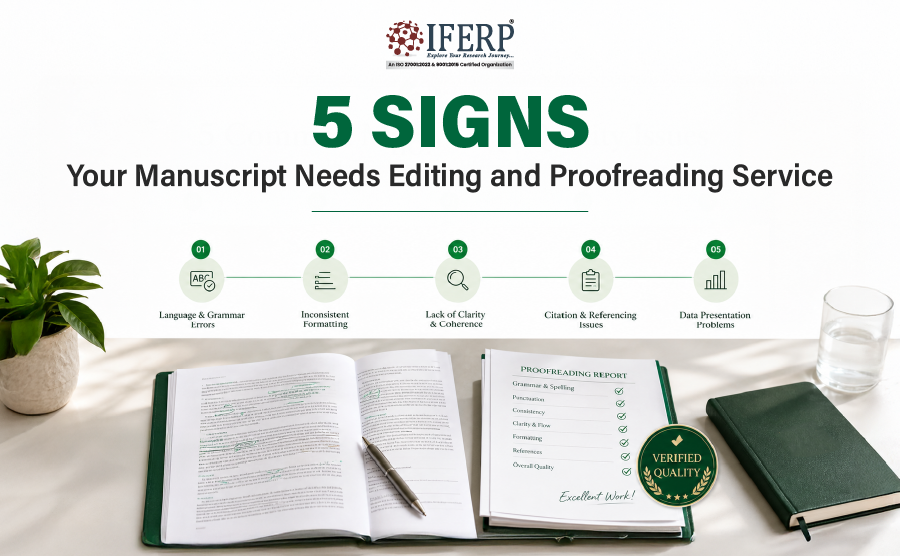
Did you know that a significant number of manuscript rejections happen due to language, clarity, and formatting issues – not the quality of the research itself?
In academic publishing, manuscript quality plays a huge role in whether your work gets accepted or not. Many students believe that strong research alone is enough, but that’s not always true. Reviewers often judge a paper not just on its findings, but on how clearly it’s written. Common issues like grammar mistakes, confusing sentences, poor structure, and wrong formatting can leave a bad impression, even if the research is solid.
This is where professional manuscript editing services can help. If you are planning to present your research at an International Conference, platforms like IFERP support students and researchers with publication guidance and manuscript improvement, helping their work appear polished, well-structured, and ready for submission. Clear writing also makes it easier for reviewers to understand your ideas and evaluate your research effectively.
So, before you submit your next manuscript, let’s explore more about why editing and proofreading matter so much.
Why Manuscript Quality Matters Before Submission
Before you hit submit, your paper needs to be ready, not just finished. Professional research editing services help researchers refine their work before it reaches journal editors. If the writing feels rough or has too many errors, your research can get overlooked even when it’s actually good.
a) First Impression on Editors
Editors look at tons of papers all the time, so they’re not going to read every line carefully if the start doesn’t grab them. The opening part of your manuscript pretty much decides whether they keep reading or move on to the next one. When your paper looks clean and put together, it tells the editor you actually cared about the work, not just the research.
b) Reviewer Experience
Reviewers are the ones who go through your paper line by line, so their experience matters more than people think.
-
If your sentences are confusing, they’ll struggle to follow your argument
-
Bad grammar or unclear phrasing slows them down and frustrates them
-
When the paper reads smoothly, they can focus on judging your research instead of fighting through your wording
c) Publication Success
This is the part students often miss – having great research isn’t always enough on its own. If your writing is hard to follow, journals may pass on it even if your data or findings are strong. At the end of the day, your manuscript has to actually communicate what you did, clearly, or it won’t go far.
d) Research Credibility
The way your paper is written says a lot about how trustworthy it looks.
-
-
Clean, clear writing makes people believe your results more easily
-
Messy writing makes readers question your work, even if it’s accurate
-
Small mistakes here and there can quietly damage how credible your research seems
-
e) Compliance with Journal Standards
Every journal has its own formatting rules, citation styles, and submission guidelines, and most students underestimate how strict they actually are. Skipping a small detail like the wrong reference style or going over the word limit can get your manuscript rejected outright, no matter how solid your content is. So it is essential to follow the Journal Publication Guide.
Sign 1: Your Manuscript Contains Frequent Grammar and Language Errors
If your paper has grammar mistakes scattered throughout, that’s usually the first red flag for reviewers. It might not seem like a big deal to you while writing, but for someone reviewing your work, it stands out fast and changes how they read everything else.
Common Grammar Issues
A few mistakes show up again and again in academic writing, and most researchers do not even notice they are doing it.
- Subject-verb agreement: This is something as simple as writing “the results shows” instead of “the results show.” It is a small slip but it happens a lot, especially when your sentences get long and complicated.
- Tense inconsistencies: This is when you describe your method in past tense and then suddenly switch to present tense while explaining your results in the same paragraph. It confuses the reader and makes your writing feel unorganized.
- Punctuation mistakes: Missing commas, wrongly placed semicolons, or sentences that just keep going without a full stop. These make your writing hard to follow and slow the reader down more than you realize.
When these mistakes pile up across pages, your paper starts to feel rushed even if the research behind it is genuinely good.
Why It Matters
- Reviewers are not pointing out grammar mistakes just to be difficult. These errors actually change how your work comes across to them.
- Every time a reviewer stops to figure out what you actually meant, they lose focus on your findings. That break in attention is the last thing you want when someone is evaluating your research.
- Messy writing makes even strong research look careless. It gives the impression that the paper was rushed out without anyone properly checking it before submission. That is not the impression you want to leave.
Sign 2: Your Research Is Difficult to Understand
You can have the most solid research in your field but if readers cannot follow what you are trying to say, none of that really matters. This is one of the most common issues reviewers bring up and most of the time it has nothing to do with the research itself. It is purely about how it is written.
- Long and Complex Sentences
A lot of researchers try to pack too many ideas into one sentence thinking it sounds more academic. But it does not. It just makes things harder to read. By the time someone reaches the end of a forty word sentence they have already forgotten what the beginning was about.
Here is a simple example of what this looks like:
Before: The results, which were obtained through a series of controlled experiments conducted over a six month period involving multiple variables and conditions that were carefully monitored, indicate a significant correlation.
After: The results were obtained through controlled experiments over six months. They show a strong correlation between the variables.
- Poor Logical Flow
Sometimes all your ideas are there but they are just not in the right order. One paragraph jumps straight to a conclusion before explaining the reasoning behind it. Or a method gets described after the results that depend on it. Readers end up going back and forth trying to piece things together on their own and that is exhausting for anyone trying to review your work fairly.
- Unclear Explanations
You know your research inside out. That is actually the problem. It becomes very easy to assume the reader knows what you know. But someone reading your paper for the first time does not have that background. When you skip steps in your explanation or use technical terms without any context, readers get lost quickly and lose trust in what you are saying even if your findings are completely accurate.
- Lack of Coherence Between Sections
Your introduction, methodology, results, and discussion should all feel like they belong to the same paper. They should connect naturally and tell one clear story from start to finish. When each section reads like it was written separately and just stitched together at the end, with no clear link between what you set out to do and what you actually found, the whole paper becomes hard to trust. Reviewers notice this more than most researchers think.
Sign 3: You Receive Repeated Reviewer Comments About Language Quality
If reviewers keep flagging language issues instead of discussing your research, your writing is the problem. This is the clearest sign you need editing and proofreading services before your next submission.
Common Reviewer Feedback That Signals a Language Problem:
- “Please have a native English speaker review this” is one of the most common things researchers hear – and it hurts every time
- Reviewers say the writing is unclear even when your research is solid
- You get the same language complaints across different journals
- Feedback focuses on grammar and sentence structure instead of your actual findings
- Reviewers suggest “significant editing” before the paper can even be considered
Language-Related Revision Requests That Slow You Down:
- You end up rewriting entire sections just to satisfy language concerns
- Days go into figuring out what confused the reviewer instead of doing new research
- You start doubting your own writing even when your science is strong
- Research paper editing could have caught these issues before submission
- The back and forth with reviewers drains your time and energy
How This Affects Your Publication Timeline:
- One revision round for language issues adds weeks to your timeline
- Two rounds can push your publication back by months
- Tenure deadlines, grant applications, and conference dates do not wait
- A single round of academic editing services before submission can save all of that time
- Getting manuscript review done early is the simplest way to avoid these delays
Sign 4: Your Manuscript Has Formatting and Consistency Issues
Journals are strict about formatting. If your manuscript looks inconsistent, editors notice it before they even read your research. Small errors in citations, terminology, or references can get your paper rejected at the desk itself. Proofreading services catch these issues before they become a reason for rejection.
- Inconsistent Terminology
Using different words for the same thing confuses reviewers. If you write “participants” in one section and “subjects” in another, it looks careless. Journal manuscript editing keeps your terminology consistent throughout.
- Citation Style Errors
Mixing citation formats is an easy mistake to make under deadline pressure. Missing publication years or mismatched in-text citations frustrate editors. Manuscript editing services fix every citation before submission.
- Formatting Problems
Different font sizes, inconsistent headings, and wrongly labeled figures are hard to spot yourself. These small issues make your manuscript look unprofessional. Research paper editing catches every formatting problem before it reaches the editor.
- Inconsistent Abbreviations
Defining an abbreviation twice or forgetting to define it at all is a common mistake. Reviewers lose track of what you mean. Publication support services make sure every abbreviation is handled correctly the first time.
- Reference List Issues
A reference in your list that is never cited in the text is a red flag for editors. Typos in author names or journal titles hurt your credibility. Manuscript review catches every mismatch between your citations and reference list.
Sign 5: English Is Not Your First Language
Many brilliant researchers do great work but struggle to express it clearly in English. That does not make your research less valuable. But journals expect language clarity, and that gap can cost you an acceptance. Academic editing services bridge that gap without changing your voice.
- Challenges Faced by Non-Native English Authors
You know exactly what you want to say – finding the right English words is a completely different skill. Sentences that make sense to you can read awkwardly to reviewers. Editing and proofreading services help you say what you actually mean.
- Academic Writing Standards
It is not just grammar. It is about how ideas flow and how formal the tone needs to be. Research paper editing brings your writing up to the level journals actually expect.
- Language Clarity Requirements
If a reviewer has to reread your sentence twice, that is already a problem. Unclear writing makes strong research look weak. Proofreading services make sure your findings come across clearly every single time.
- Global Journal Expectations
Top journals get submissions from researchers worldwide. Your manuscript needs to compete at that level. Journal manuscript editing levels the playing field so your research gets judged on its merit, not your language background.
Editing vs Proofreading: Understanding the Difference
Most researchers use these two words like they mean the same thing – they do not. Editing fixes how your content is structured and flows. Proofreading catches surface errors. You need both before submitting.
| Feature | Editing | Proofreading |
| Grammar Correction | Yes | Yes |
| Readability Improvement | Yes | Limited |
| Sentence Restructuring | Yes | No |
| Style Enhancement | Yes | No |
| Final Error Check | Limited | Yes |
Conclusion
Strong research deserves to be read, understood, and accepted. But if your manuscript has grammar issues, unclear writing, formatting problems, or language barriers, even the best research can get rejected. These five signs are not something to ignore.
At IFERP, we have been helping researchers and students present their work with clarity and confidence. If your manuscript needs a professional eye before submission, our publication support services are built exactly for that. From research paper editing to full journal manuscript editing, we guide you every step of the way toward successful research publication.
Get your manuscript edited by our experts today!
Faqs
- What do manuscript editing services actually check in a research paper?
A lot more than most people expect. They go through your grammar, how your sentences read, whether your argument actually makes sense from start to finish, formatting, citations, and consistency. It is a full check, not just a quick spell check.
- How do editing and proofreading services work differently for academic papers?
Think of it this way – editing is like renovating a house and proofreading is like cleaning it before the guests arrive. Editing fixes the structure and flow. Proofreading catches the leftover errors. You really do need both before you hit submit.
- What kind of errors does research paper editing fix that researchers usually miss?
The ones you stop seeing after staring at the same document for weeks. Things like using two different words for the same concept, switching tenses without realizing it, or explaining something in a way that makes sense to you but confuses everyone else reading it for the first time.
- How does academic editing help non-native English researchers specifically?
You already know your research inside out. The hard part is getting it to read the way English journals expect. Academic editing services work on your sentence structure, tone, and word choices without touching your actual findings or changing what you are trying to say.
- What does a proper manuscript review cover beyond just grammar checking?
Quite a bit actually. It looks at whether your sections connect properly, if your citations match your reference list, whether your formatting follows journal guidelines, and if your argument flows in a logical order. Grammar is just one small part of it.
- How does journal manuscript editing improve chances of acceptance?
Reviewers decide pretty quickly whether a paper is worth their time. If your writing is clear and your paper looks clean, they spend their energy on your research. If it is not, they spend it trying to figure out what you meant – and that never ends well for the author.
- At what stage of writing should I use proofreading services?
Right at the end, once you are completely done making changes. A lot of researchers make the mistake of proofreading too early and then editing again after, which just brings new errors back in. Do all your editing first, then send it for proofreading right before journal submission.
- What are the most common reasons manuscript formatting gets rejected during journal submission?
Wrong citation style is a big one. So are mismatched references, inconsistent headings, and figures that are not labeled the way the journal asks. Some journals reject papers purely on formatting before a single reviewer even reads them.
- How do publication support services help researchers who are submitting for the first time?
First time submissions are stressful because every journal has its own set of rules and most of them are not flexible. Publication support services walk you through what the journal expects so you are not figuring it all out on your own under deadline pressure.
- How does getting a manuscript edited early affect the overall research publication timeline?
It cuts out a lot of unnecessary back and forth. When your paper comes back with language or formatting issues, you lose weeks fixing things that could have been caught before submission. Getting it edited early means fewer rejection rounds and a much smoother path to research publication.
Editing & Proofreading Services
Build Your Academic CV with IFERP AI Resume Builder
Scopus Indexed Conferences 2026
-
9th International Conference on Multidisciplinary and Current Educational Research (ICMCER)

-
9th International Conference on Recent Trends in Multi-Disciplinary Research (ICRTMDR)
-
50th World Conference on Applied Science, Engineering & Technology (WCASET)
-
9th International Conference on Dentistry and Oral Health (ICDOH-2026)
News
- Siddth Jain and Rudra’s IFERP is Empowering a Global Research Community
- From Idea to Funding: IFERP's Guide to Successful Grant Applications
- Protecting Researchers: IFERP’s Guide To Identifying And Avoiding Hijacked Journals
- The Power of Networking: How IFERP memberships open doors to global opportunities for universities
- IFERP bridges academia and industry for global sustainability
- Ballot Education Project takes center stage: Bridging theory and practice at International Conference
- IFERP Spearheads Global Sustainable Development Through Research & Innovation