
What is Scopus Q1, Q2, Q3, Q4?

 December 24, 2025

Scopus is the most trusted database for evaluating the quality of academic journals globally. For researchers, scholars, and faculties, publishing in Scopus indexed journals 2026 is a prerequisite for PhD completion, academic promotions, research funding, and institutional recognition. However, many authors are often confused by terms like Scopus Q1, Q2, Q3, and Q4 and what these rankings actually mean.
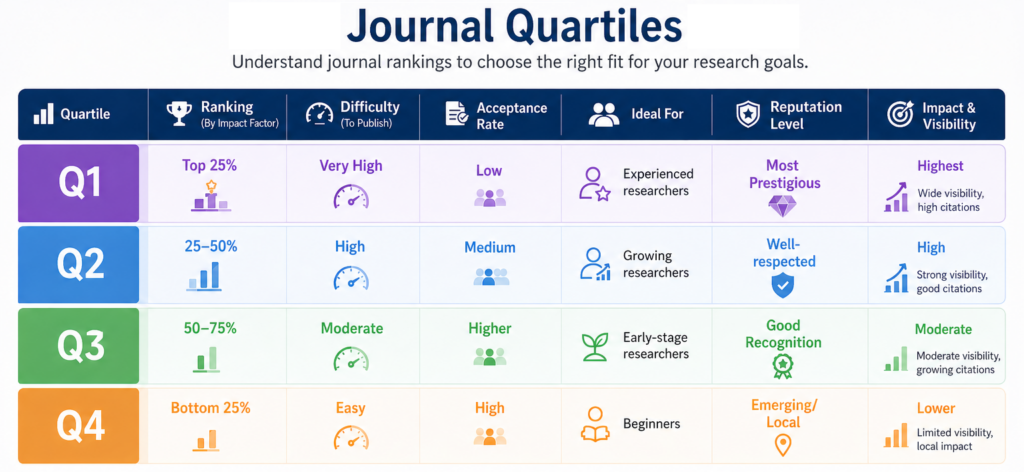
Basically, Scopus quartiles are used to classify journals based on their academic impact and citation performance within a specific subject area.:
- Q1: Top-tier
- Q2: Upper-mid level
- Q3: Mmid-range
- Q4: Entry level
Each quartile serves a different purpose depending on the researcher’s goals, experience, and publication timeline. Understanding these categories is essential for choosing the right journal and avoiding common mistakes.
Let’s begin by understanding what Q1, Q2, Q3, and Q4 journals are, how they are ranked, and the key differences between them. By the end, you’ll be able to make an informed decision for your research publication journey.
What Are Scopus Quartiles (Q1, Q2, Q3, Q4)?
Scopus quartiles (Q1, Q2, Q3, and Q4) are a ranking system used to classify Scopus indexed journals based on their relative academic impact within a specific subject category. These quartiles help researchers quickly understand the quality and influence of a journal by comparing it with other journals in the same field.
Each subject category in Scopus is divided into four equal groups. Q1 journals represent the top 25% with the highest citation impact, followed by Q2 journal fast publication Scopus (25%–50%), Q3 journals (50%–75%), and Q4 journals (the bottom 25%). It is important to note that quartiles are updated annually, meaning a journal’s rank can change over time based on performance.
What is Q1 Scopus Indexed Journals?
Q1 Scopus indexed journals are the highest-ranked journals within the Scopus database, positioned in the top 25% of journals in their respective subject categories. These journals demonstrate exceptional academic influence, measured through strong citation performance, high SCImago Journal Rank (SJR) values, and consistent research visibility. Publishing in Q1 Scopus journals is widely regarded as a mark of research excellence and international credibility.
Scopus indexed journals 2026 are known for their rigorous peer-review processes, strict editorial standards, and highly experienced editorial boards composed of leading experts from around the world. As a result, acceptance rates are typically low, and the review process may take longer compared to lower-quartile journals. However, the quality control ensures that published articles contribute significantly to advancing knowledge in their field.
For researchers, publishing in a Q1 Scopus indexed journal offers major advantages, including higher citation potential, stronger academic reputation, and greater recognition for career advancement, promotions, and research funding. Q1 journals are particularly suitable for well-developed, original, and high-impact studies. While they require patience and precision, they remain the preferred choice for authors aiming for long-term academic impact rather than rapid publication alone.
What is Q2 Scopus Indexed Journals?
Q2 Scopus indexed journals list fall within the second quartile, ranking between the top 25% and 50% of journals in a specific subject category. These journals maintain strong academic standards and credibility while offering a more balanced combination of quality, visibility, and accessibility compared to Q1 journals. For many researchers, Q2 Scopus indexed journals list represent a practical and strategic publishing option.
Q2 journals follow a robust peer-review process and publish research that is methodologically sound and relevant to the field, though they may not always demand the same level of novelty or citation impact as Q1 journals. Acceptance rates are generally higher, and review timelines are often shorter, making Q2 journals attractive to early-career researchers, PhD scholars, and authors working under academic or funding deadlines.
Publishing in a Q2 Scopus indexed journal still provides significant academic recognition and is widely accepted for doctoral requirements, faculty promotions, and institutional evaluations in many countries. Many universities and research bodies explicitly recognize Q2 publications as high-quality outputs. Additionally, Q2 journals are often more open to applied research, interdisciplinary studies, and region-specific topics, making them an excellent choice for researchers seeking credibility without the extreme competition of top-tier journals.
What is Q3 Scopus Indexed Journals?
Q3 Scopus indexed journals are positioned in the third quartile, ranking between the 50% and 75% range within a specific subject category. These journals demonstrate moderate academic impact and are often more specialized, regional, or emerging in scope. While their citation metrics are lower than Q1 and Q2 journals, Q3 journals still meet Scopus’s minimum quality and ethical standards.
Q3 journals typically have higher acceptance rates and more flexible editorial criteria, making them suitable for early-stage researchers, postgraduate students, and authors publishing focused studies, case reports, or region-specific research. The peer-review process is generally less competitive, and review timelines may be shorter, which can be helpful for authors seeking timely publication.
Although Scopus indexed journals may carry less weight for highly competitive promotions or funding opportunities, they are still recognized by many universities and institutions. When chosen carefully, Q3 journals can serve as a valuable platform for building publication experience and establishing a research track record.
What is Q4 Scopus Indexed Journals?
Q4 Scopus indexed journals belong to the fourth quartile, ranking in the bottom 25% of journals within a specific subject category based on citation performance. These journals generally have lower impact metrics and are often newly indexed, niche-focused, or still developing their academic visibility. Despite their lower ranking, Q4 journals must still meet Scopus’s baseline standards for peer review, editorial quality, and publication ethics.
Q4 Scopus journals usually have higher acceptance rates and less competitive submission requirements, making them suitable for first-time authors, postgraduate students, and researchers publishing preliminary findings or localized studies. Review and publication timelines may also be shorter compared to higher-quartile journals.
However, Q4 publications may carry limited weight for faculty promotions, international recognition, or competitive funding applications. Many institutions place greater value on Q1 and Q2 outputs. Therefore, while Q4 Scopus indexed journals can be useful for gaining initial publishing experience, researchers should carefully assess their long-term academic goals before selecting a Q4 journal.
How to Check Scopus Quartile of a Journal
Checking the Scopus quartile of a journal is an essential step before submitting your research, as quartile rankings can change every year. The most reliable way to verify a journal’s quartile is through the SCImago Journal Rank (SJR) website, which uses Scopus data to classify journals into Q1, Q2, Q3, or Q4 within specific subject categories.
To check a journal’s quartile, visit the SJR platform and search for the journal by its title or ISSN number. Once selected, review the journal’s profile, where you will find its current quartile ranking, SJR indicator, subject areas, and historical performance. Pay close attention to the latest year’s ranking, as older quartile claims are often misleading.
It is also important to note that a journal may have different quartile rankings across different subject categories. Always confirm the quartile that aligns with your research field. Avoid relying solely on journal websites or third-party claims; always cross-check with official Scopus-based sources to ensure accuracy and credibility.
Also Read: How to check Scopus quartile?
Conclusion
Understanding Scopus quartiles, Q1, Q2, Q3, and Q4, is essential for making informed publication decisions. Q1 journals offer maximum visibility and impact but are highly competitive, while Q2 journals balance quality with faster publication timelines, making them suitable for many researchers. Q3 and Q4 journals provide opportunities for early-career or niche-focused studies. By selecting journals strategically, researchers can maximize academic recognition, maintain credibility, and ensure their work contributes meaningfully to their field.
Frequently Asked Questions
Is Q2 Scopus Indexed Journals 2026 good for PhD or promotion?
Yes, Q2 Scopus indexed journals are widely recognized for academic evaluations. They provide credible research visibility, faster publication timelines than Q1 journals, and are generally accepted by universities and funding bodies for PhD submissions, faculty promotions, and research assessment. They balance quality and accessibility effectively.
Are Q4 journals still Scopus indexed?
Yes, Q4 journals remain officially Scopus indexed, meeting the minimum standards for peer review, editorial quality, and ethics. However, they rank in the bottom 25% within their subject category, meaning their citation impact is lower. They are suitable for initial publications or niche studies but carry less weight for career evaluation.
Can a journal move from Q4 to Q1?
Yes, a journal’s quartile ranking can change annually based on citation performance and other metrics like CiteScore or SJR. If a Q4 journal improves in quality, citation impact, and editorial practices, it can rise to Q3, Q2, or even Q1. Regularly checking official Scopus-based sources is essential for updated rankings.
Are fast publication Scopus journals safe?
Q3 and Q2 journal fast publication are generally safe because they maintains proper peer review and ethical standards. Avoid journals promising guaranteed acceptance or unrealistically short timelines, as these may be predatory. Verify indexing and quartile through SCImago or Scopus to ensure credibility.
Editing & Proofreading Services
Build Your Academic CV with IFERP AI Resume Builder
Scopus Indexed Conferences 2026
-
9th International Conference on Multidisciplinary and Current Educational Research (ICMCER)

-
9th International Conference on Recent Trends in Multi-Disciplinary Research (ICRTMDR)
-
50th World Conference on Applied Science, Engineering & Technology (WCASET)
-
9th International Conference on Dentistry and Oral Health (ICDOH-2026)
News
- Siddth Jain and Rudra’s IFERP is Empowering a Global Research Community
- From Idea to Funding: IFERP's Guide to Successful Grant Applications
- Protecting Researchers: IFERP’s Guide To Identifying And Avoiding Hijacked Journals
- The Power of Networking: How IFERP memberships open doors to global opportunities for universities
- IFERP bridges academia and industry for global sustainability
- Ballot Education Project takes center stage: Bridging theory and practice at International Conference
- IFERP Spearheads Global Sustainable Development Through Research & Innovation